Hire Healthcare IT Professionals — Developers, Designers & Support Staff for Health Tech
Healthcare IT requires developers who understand HL7/FHIR standards, HIPAA compliance, electronic health record workflows, and clinical terminology. Generic software teams lack the domain expertise for EMR integrations, lab information systems, or patient portal security — leading to compliance gaps, failed audits, and rework. When you hire healthcare IT specialists with hands-on hospital software experience, you avoid costly mistakes like unencrypted patient data storage, broken HL7 interfaces, and missing audit trails that trigger regulatory violations.
Whether you're building a hospital management system, laboratory information system, telehealth platform, or patient portal, our healthcare IT professionals bring domain expertise that generic developers lack. We're not a staffing agency recruiting from job boards — we build hospital software ourselves (EloHIMS), so you're hiring from a team that ships EMR modules, LIMS workflows, and HIPAA-compliant architectures in production.
Why Healthcare IT Projects Need Specialized Staff
Healthcare software is fundamentally different from generic SaaS development. HIPAA mandates encryption at rest and in transit, comprehensive audit logging, role-based access controls, and breach notification protocols. Clinical workflows involve complex sequences: HL7 messaging for patient admissions (ADT messages), lab result validation chains requiring two-tier authorization, medication orders through CPOE systems with allergy checks, and patient identifiers (Medical Record Numbers) that must maintain integrity across departments.
Regulatory pitfalls multiply when developers lack healthcare domain knowledge. In Pakistan, the Punjab Healthcare Commission (PHC) and Sindh Healthcare Commission (SHCC) require hospitals to maintain statutory registers for births, deaths, admissions, discharges, surgeries, and emergency visits — all with specific data fields and retention periods. In the United States, HIPAA violations carry penalties up to $1.5 million per violation category annually, and a single breach affecting 500+ patients triggers mandatory HHS notification. In the European Union, GDPR applies to health data with fines reaching 4% of annual global revenue.
Generic developers make costly mistakes because they don't understand these constraints. Common failures include:
- Unencrypted PHI storage: Storing patient names, diagnoses, or test results in plain text databases without AES-256 encryption
- Missing audit trails: No logging of who accessed which patient record when, making it impossible to investigate privacy complaints or pass audits
- Broken HL7 interfaces: Malformed HL7 v2 messages (incorrect segment delimiters, missing required fields like PID-3 for patient ID) that cause lab analyzers or radiology equipment to reject data
- Incorrect CPOE logic: Medication ordering systems that don't check for drug-drug interactions, allergy contraindications, or duplicate orders — creating patient safety risks
- Non-compliant data retention: Deleting patient records too soon (violating 5-10 year retention requirements) or keeping them forever (violating data minimization principles)
EloHIMS builds hospital management systems covering OPD, IPD, laboratory (LIMS), radiology (RIS), pharmacy, billing, and compliance registers. Our staff augmentation team comes from this background — developers who've implemented ISO 15189-ready laboratory information systems, HL7 interfaces for patient admissions, CPOE medication workflows, and PHC statutory register automation. When you hire from our talent pool, you're accessing healthcare IT expertise that's been tested in production hospital environments, not generic coders learning clinical terminology for the first time.
Roles We Staff
We provide dedicated healthcare IT professionals across six disciplines. Each role is available as a full-time dedicated resource (160 hours/month) or part-time engagement (80 hours/month). All team members work directly with you — no intermediaries, no handoffs, no project managers consuming billable hours. You manage their daily work, they join your Slack or Microsoft Teams, commit to your GitHub repositories, and attend your sprint ceremonies.
1. Healthcare Software Developers
Technologies: Laravel/PHP for hospital backend systems, React/Next.js for patient portals and clinical dashboards, Node.js for HL7 interface engines, mobile development (React Native, Flutter) for telehealth apps and bedside charting.
Domain expertise:
- EMR/EHR integrations including HL7 v2 messaging (ADT, ORM, ORU message types for admissions, lab orders, results) and FHIR R4 APIs (Patient, Observation, Encounter resources)
- Laboratory information system workflows: sample registration with barcode generation, result entry forms with reference range validation, two-tier authorization (technologist validation + pathologist medical approval), critical value alerts, TAT tracking with breach notifications
- HIPAA-compliant architecture including encryption at rest (AES-256 for database columns containing PHI), encryption in transit (TLS 1.2+), audit logging (who accessed which patient record when), access controls (role-based permissions for physicians vs nurses vs billing staff)
- Pharmacy FEFO logic (First Expiry First Out) with batch tracking, expiry alerts, automatic cost-of-goods-sold posting
- Clinical terminology standards: ICD-10 diagnosis codes, CPT procedure codes, LOINC lab test codes, RxNorm medication codes
Example deliverables: HL7 ADT interface for patient admissions (real-time patient demographic sync between HMS and lab analyzer), FHIR API for EHR interoperability (exposing patient records to authorized third-party apps), HIPAA audit log system tracking all PHI access with tamper-proof timestamps, lab barcode tracking module (sample receipt → storage → analysis → result entry chain-of-custody).
2. Medical Web & UI/UX Designers
Specialization: Clinical dashboards optimized for physician workflows (minimizing clicks for charting during patient encounters), nurse charting screens (medication administration records with barcode scanning), patient-facing portals (appointment booking, lab result viewing, secure messaging), accessibility compliance (WCAG 2.1 Level AA for health literacy — readable by elderly patients and those with disabilities).
Domain expertise: Medical iconography (universally recognized symbols for allergies, critical values, pending orders), color-blindness-safe palettes (avoiding red-green combinations for lab result flags), readable typography for elderly patients (minimum 16px body text, high contrast ratios), responsive design for bedside tablets (nurse workflows on 10-inch hospital carts) and physician mobile access (on-call doctors reviewing lab results on phones).
Example deliverables: ICU monitoring dashboard showing real-time vitals (heart rate, blood pressure, oxygen saturation) with configurable alert thresholds, patient portal UI redesign improving appointment booking completion rates, EHR charting screen optimization reducing physician documentation time by 30% through auto-complete templates and voice-to-text integration.
3. Healthcare DevOps & Cloud Engineers
Technologies: AWS and Azure with HIPAA-eligible regions (us-east-1 GovCloud, Azure Government), Docker and Kubernetes for containerized hospital microservices, Terraform for infrastructure-as-code, CI/CD pipelines (GitHub Actions, Jenkins) with automated security scanning.
Domain expertise: HIPAA infrastructure requirements including Business Associate Agreements (BAAs) with cloud providers, encryption at rest and in transit for all PHI, network isolation (VPCs with private subnets for database tiers), disaster recovery planning for 24/7 hospital systems (RTO under 4 hours, RPO under 15 minutes), performance optimization for high-volume lab data (diagnostic labs processing 1,000+ samples daily with image storage for pathology slides).
Example deliverables: HIPAA-compliant AWS architecture with encrypted RDS databases (AES-256), S3 buckets for DICOM medical images (server-side encryption with KMS), VPC configuration isolating PHI from public internet; auto-scaling for patient portal traffic spikes (appointment booking during business hours); encrypted backup strategy with 7-year retention for medical records (HIPAA requirement) and automated backup verification.
4. QA & Test Engineers (Healthcare Focus)
Specialization: Clinical workflow testing covering complete patient journeys (OPD registration → physician consultation → lab order → sample collection → result entry → physician review → patient notification), HL7 message validation (checking segment structure, required fields, data types per HL7 v2.5.1 specification), compliance test cases (verifying HIPAA audit logs capture all PHI access, PHC statutory registers auto-populate with correct data fields).
Domain expertise: Regression testing for hospital modules (ensuring billing changes don't break lab order entry), lab equipment integration testing (sending test orders to chemistry analyzers, barcode scanners, ensuring responses parse correctly), load testing for appointment booking systems (simulating 500 concurrent patients during morning rush), edge case testing for clinical logic (what happens when a patient is transferred between departments mid-treatment, how does the system handle duplicate lab orders).
Example deliverables: Automated test suite for EMR medication orders covering CPOE workflows (duplicate order detection, allergy contraindication alerts, dose range validation), HL7 interface validation scripts (sending sample ADT/ORM/ORU messages, asserting correct ACK responses, checking database state), compliance checklist automation (PHC register field validation, HIPAA audit log completeness checks run nightly).
5. Healthcare Data Analysts & Reporting Specialists
Technologies: SQL for hospital databases (complex joins across patient, visit, lab, billing tables), Power BI and Tableau for executive dashboards, Python with pandas for clinical analytics (calculating average length of stay, bed occupancy rates, revenue per patient visit).
Domain expertise: Hospital KPIs including average length of stay (ALOS — target under 4 days for general wards), bed occupancy rates (target 75-85% for optimal revenue vs flexibility), revenue per patient (analyzing contribution margins by department: OPD, IPD, diagnostics, pharmacy), PHC/SHCC compliance reports (automating statutory register exports in required CSV formats), lab turnaround time analysis (measuring sample receipt to result authorization time, identifying bottlenecks).
Example deliverables: Monthly PHC statutory registers automation (births, deaths, ADT, surgeries) exported to Excel with validation checks for missing fields, OPD vs IPD revenue dashboard with drill-down by physician and department, lab turnaround time analysis identifying which test categories exceed target TAT (e.g., microbiology cultures taking 4 days instead of target 3 days).
6. Healthcare IT Support & Help Desk
Specialization: Hospital software user support for clinical staff (physicians, nurses, lab technicians, front desk registration), troubleshooting clinical workflows (investigating missing lab results — was the order entered correctly? did the barcode scan? is the result pending authorization?), training hospital staff on new modules or workflow changes.
Domain expertise: EMR navigation (teaching nurses how to chart vitals, document medications administered), lab order entry (showing physicians how to select tests, mark orders STAT for urgent processing), pharmacy dispensing workflows (training pharmacists on batch selection, FEFO picking logic, stock adjustment entry), insurance panel configurations (explaining how to bill different rates for panel patients vs cash).
Languages: English plus Urdu for Pakistan hospital staff (explaining features in local language improves adoption — "ye FEFO ka matlab hai First Expiry First Out, batch jo pehle expire hogi wo pehle issue hogi").
Example deliverables: 24/7 help desk for hospital users handling 50-100 tickets daily (password resets, "how do I…" questions, bug reports triaged to developers), user training videos for nurses (5-minute screencasts showing medication administration charting workflow), troubleshooting HL7 interface failures (investigating why lab orders aren't reaching analyzer — checking network connectivity, message logs, database queue tables).
How Staff Augmentation Works for Healthcare IT
You interview candidates, approve your team, and manage work directly. We handle payroll, benefits, HR compliance, and infrastructure. Your dedicated staff work your hours (or your preferred timezone with overlap windows), attend your daily standups, and commit code to your repositories just like in-house employees — except you avoid recruitment overhead, employment taxes, and long-term liabilities.
Step 1: Define Your Needs (1-2 days)
You provide: Role description (e.g., "Senior Laravel developer for HL7 integrations in hospital management system"), specific technology stack (Laravel 10, MySQL 8, Redis for queues, Vue.js frontend), hours per month (80 for part-time, 160 for full-time equivalent), desired start date.
We ask: Domain requirements (Is HIPAA compliance required? PHC statutory registers? Lab workflows or pharmacy or both?), existing system details (Which EHR vendor are you integrating with? Database schema — do you have patient, visit, order tables designed?), deliverables (Are you building a new module from scratch, maintaining existing code, or fixing bugs?), timeline expectations (Is this a 3-month project or 12-month ongoing product development?).
Output: Job specification document with technical requirements (languages, frameworks, databases, APIs) plus domain requirements (HL7 message types, HIPAA controls, clinical workflows), shared via Google Docs for your review and approval. Average turnaround: 1 business day.
Step 2: Candidate Shortlisting (3-5 days)
Our process: We screen 50-100 candidates from our healthcare IT talent pool — developers who've worked on EloHIMS modules, client hospital projects, diagnostic lab implementations. We're not posting to job boards; we're drawing from engineers who've already shipped hospital software in production.
Domain assessment: We test HL7 knowledge (asking candidates to parse an ADT message, identify segments, explain PID vs PV1), HIPAA awareness (what are the three types of safeguards? how do you handle PHI in logs?), clinical terminology (what's the difference between OPD and IPD? what does CPOE stand for? what's a STAT order?). This is not just generic coding tests — we're validating healthcare domain competence.
You receive: 3-5 pre-vetted candidate profiles including CVs with healthcare project experience, GitHub links showing relevant code samples (HL7 parsers, EMR modules, LIMS workflows), portfolio descriptions of hospital projects (client names withheld per NDAs, but we describe: "Implemented lab barcode tracking for 200-bed hospital diagnostic center"), hourly rate quote based on seniority and specialization (HL7 integration specialists command premium rates vs generic Laravel developers).
Step 3: Interviews & Selection (1 week)
You control hiring: Interview candidates directly via Zoom or Google Meet (we send calendar invites with candidate bios), assign practical test tasks (e.g., "Parse this HL7 ADT message and extract patient name, MRN, admission date" or "Design a database schema for lab sample tracking with chain-of-custody"), check cultural fit and communication skills (critical for remote collaboration — can they explain technical decisions clearly?).
We coordinate: Schedule interviews around your timezone and availability, provide healthcare-specific interview question templates (sample questions: "How would you implement two-tier authorization for lab results? Walk me through your HL7 interface error handling strategy. How do you prevent race conditions when two nurses chart vitals simultaneously?"), collect your feedback after each interview (thumbs up, thumbs down, concerns to address in next candidate).
Output: Signed service agreement with your chosen candidate(s), start date confirmed, onboarding checklist shared (accounts to create, repositories to grant access to, training materials to prepare).
Step 4: Onboarding & Ongoing Management (Day 1 onward)
Week 1: Developer(s) receive access to your GitHub organization or GitLab groups, join your Slack workspace or Microsoft Teams, attend sprint planning and backlog grooming, receive domain training on your specific EHR/LIMS workflows (we encourage you to do a 2-hour walkthrough: "Here's how our patient registration works, here's our database schema, here's how we handle HL7 messages from the lab analyzer").
Ongoing: They work your timezone or overlap 4-6 hours if you're in a distant timezone (e.g., Pakistan Time is UTC+5, which overlaps with EU mornings 9am-1pm CET; US clients typically do async via GitHub pull requests and Slack updates, with optional overlap windows 12pm-3pm PKT = 3am-6am EST for critical discussions). They attend daily standups, submit weekly timesheets via our portal (you review and approve hours before invoicing), participate in code reviews and sprint retrospectives exactly like in-house team members.
We handle: Monthly payroll processing, health benefits and statutory employment taxes in Pakistan, laptop and equipment provisioning, HR issues (sick leave, vacation coverage — we provide backup staff from the same talent pool if your developer is unavailable), workspace costs (developers work from our offices or secure home offices with VPN requirements for client system access, never public WiFi when handling PHI).
Replacement policy: 30-day satisfaction guarantee (if you're not satisfied with a developer's performance, domain knowledge, or communication in the first month, we replace them for free with no additional fees or questions asked). After 30 days, either party can terminate with 2 weeks' written notice. If you need continuity, we provide a replacement within 1 week — we maintain a bench of pre-vetted backup candidates specifically to minimize disruption when team changes occur.
Pricing Models for IT Staff Augmentation (Pakistan & Global Markets)
Healthcare IT staffing follows three common models: hourly dedicated resources (most flexible, pay only hours worked with weekly approval), monthly retainers (fixed monthly fee for guaranteed capacity — e.g., 160 hours full-time or 80 hours part-time), and project-based contracts (fixed scope plus timeline with milestone payments). We primarily offer dedicated monthly resources because healthcare projects need continuity — developers who understand your hospital's specific workflows, database schema, and clinical terminology, not task-based freelancers who disappear after one feature.
Typical market rates for Pakistan IT staff augmentation (2026):
- Junior developers (1-3 years experience, Laravel/React basics, basic HL7 awareness): $25-$35/hour
- Mid-level developers (3-5 years, hands-on HL7/FHIR integration experience, HIPAA implementation): $35-$50/hour
- Senior developers (5+ years, HIPAA architecture design, complex hospital integrations, mentoring ability): $50-$65/hour
- UI/UX designers (healthcare dashboard specialization, WCAG accessibility): $30-$45/hour
- QA engineers (healthcare domain test coverage, HL7 validation): $25-$40/hour
- Support staff (bilingual English/Urdu, clinical workflow troubleshooting): $20-$30/hour
Why Pakistan for healthcare IT?
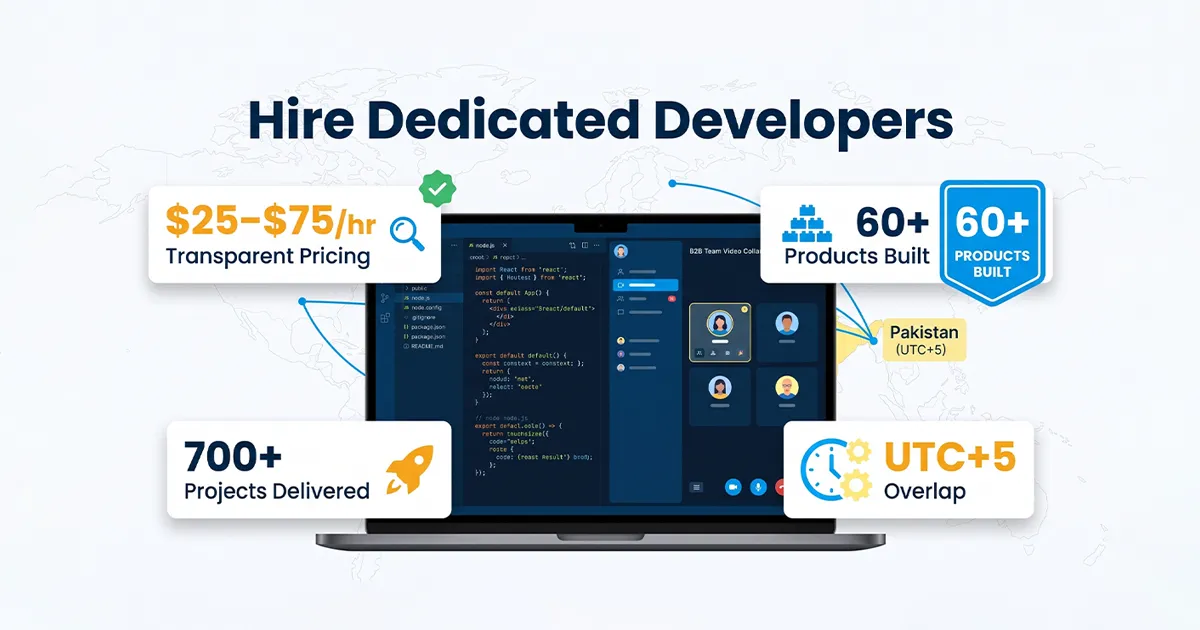
Cost advantage: 40-60% lower than US/EU rates. A senior US-based healthcare software developer in major metros (New York, San Francisco, Boston) typically commands $120-$180/hour, compared to $50-$65/hour for comparable Pakistan-based talent. For a full-time dedicated senior developer (160 hours/month), this translates to $8,000-$10,400/month from Pakistan vs $19,200-$28,800/month for US-based, saving $10,000-$18,000 monthly per developer.
English fluency plus clinical terminology: Pakistan's IT workforce is English-medium educated (university instruction in English, technical documentation reading/writing skills). Many developers have worked on US/UK health tech projects and are familiar with clinical terminology (understanding terms like CPOE, STAT orders, turnaround time, Medical Record Numbers without needing translation).
Timezone overlap: Pakistan Time (PKT, UTC+5) overlaps 4-6 hours with European business hours (9am PKT = 5am CET, by noon CET it's 4pm PKT giving morning overlap for meetings). US clients typically work async-first (developers push code during US nighttime, US teams review in their morning) with manageable 9-hour offset — some teams schedule optional overlap windows (12pm-3pm PKT = 3am-6am EST) for critical sprint planning, though most prefer asynchronous GitHub pull request workflows.
Regulatory awareness: Developers familiar with PHC/SHCC requirements (Punjab Healthcare Commission and Sindh Healthcare Commission — Pakistan's healthcare regulators) understand compliance concepts like audit trails, statutory registers with specific data fields, infection control logging, Medical Registration Certificate validation. This regulatory awareness transfers to HIPAA contexts (both frameworks require: who did what when logging, data retention policies, access controls, privacy safeguards).
Note: Final pricing depends on seniority level, technology stack complexity (HL7 integration specialists cost 15-20% more than generic Laravel developers due to specialized domain knowledge), and engagement length (6+ month contracts receive 10-15% volume discounts as long-term commitments reduce our recruitment and onboarding overhead). Contact us for a custom quote based on your specific requirements.
Why Choose IT Vision for Healthcare IT Staffing
We don't just staff developers — we're a healthcare software company that offers staff augmentation. Our flagship product is EloHIMS, a comprehensive hospital management system covering OPD, IPD, laboratory (LIMS), radiology (RIS), pharmacy, billing, and compliance registers. Our team has built OPD EMR workflows with CPOE medication ordering, HL7 interfaces for patient admissions and lab results, ISO 15189-ready LIMS with two-tier authorization, and PHC statutory register automation. You're hiring from a pool that ships hospital software in production, not generic outsourcing agencies recruiting from job boards.
1. Healthcare Domain Expertise (Not Generic Outsourcing)
Our product: EloHIMS — a unified cloud hospital information system covering the complete patient journey from registration through discharge. Key modules include Patient Registration with MRN assignment, OPD Queue Management with EMR charting, Inpatient ADT (admission-discharge-transfer) with bed management, CPOE for medication orders, Laboratory Information System with barcode sample tracking, Radiology Information System for imaging workflow, Pharmacy with FEFO batch logic, Billing with insurance panel support, and PHC/SHCC statutory compliance registers.
Team background: Developers have implemented HL7 ADT/ORM/ORU interfaces (patient admissions, lab orders, lab results messaging), ISO 15189-ready laboratory information systems with two-tier verification (technologist validation plus pathologist medical authorization), CPOE medication workflows with drug-drug interaction checks, pharmacy FEFO logic with automatic cost-of-goods-sold posting to accounting GL, and PHC statutory registers (births, deaths, ADT, surgeries, ER visits) with automated field population and CSV export.
vs. competitors: Generic IT staffing agencies offer "mobile app developers" or "React developers" with no healthcare experience. They've never debugged an HL7 ADT message with incorrect segment delimiters, designed a HIPAA audit log schema that survives forensic investigation, or implemented two-tier lab result authorization where a technologist validates the result but can't release it until a pathologist provides medical approval. Healthcare software has domain-specific complexity that generic developers learn slowly through expensive mistakes on your project.
2. Compliance-Aware (HIPAA, PHC, SHCC)
HIPAA training: Our healthcare IT developers understand Protected Health Information (PHI) encryption requirements (AES-256 for data at rest, TLS 1.2+ for data in transit), role-based access controls (physicians see all patients, nurses see only their assigned ward, billing staff see demographics but not clinical notes), audit logging requirements (capturing who accessed which patient record when with tamper-proof timestamps), breach notification procedures (any PHI exposure affecting 500+ individuals triggers mandatory HHS notification within 60 days).
Pakistan regulatory context: Developers are familiar with PHC (Punjab Healthcare Commission) and SHCC (Sindh Healthcare Commission) compliance requirements including statutory registers with specific data fields (birth register must capture mother's name, baby weight, delivery type; death register must capture time of death, cause, physician name), infection control logs, Medical Registration Certificate (MRC) validation for physicians, and pharmacy narcotics tracking. This regulatory awareness — understanding that healthcare software must satisfy external auditors, not just internal users — transfers directly to HIPAA and international healthcare compliance contexts.
Data security practices: All staff sign Non-Disclosure Agreements (NDAs) before accessing client projects, work from secure offices or home offices with VPN requirements for client system access (never public WiFi when handling PHI), use company-issued laptops with full-disk encryption and remote wipe capability, and follow least-privilege access principles (developers receive only the minimum database permissions needed for their assigned tasks — no production database access for junior developers, read-only access for QA staff).
3. Proven Hospital Software Track Record
EloHIMS features built by this team: OPD queue management with token-based patient flow and physician workload balancing, laboratory barcode tracking (sample collection → storage → analysis → result entry chain-of-custody with barcode scanning at each step), pharmacy FEFO with batch/expiry tracking and automated stock rotation, double-entry accounting general ledger with automatic journal entries for every clinical transaction (lab charges, pharmacy dispensing, refunds all post to GL in real-time), compliance registers automation (PHC statutory registers auto-populate from patient admission, discharge, surgery, birth, death events with field validation preventing incomplete records).
Client projects: Hospital billing integrations (connecting legacy HMS to insurance company APIs for electronic claim submission), diagnostic lab LIMS implementations (deploying barcode sample tracking and two-tier authorization for ISO 15189 accreditation preparation), patient portal builds (React/Next.js portals allowing patients to book appointments, view lab results, download prescriptions, message physicians securely).
4. No Middlemen — You Manage Directly
Direct access: Your developers join your Slack or Microsoft Teams workspace, commit code to your GitHub or GitLab repositories, attend your daily standups and sprint ceremonies via Zoom/Google Meet, receive task assignments through your Jira or Linear or Asana boards. You are their product manager and technical lead — they report to you daily, not to a project manager at our company consuming billable hours with status meetings.
No intermediary layers: We handle payroll processing, benefits administration, HR compliance (employment taxes, contracts, workspace costs), but we do NOT insert project managers between you and the developers. You approve timesheets weekly (developers log hours in our portal, you review and approve before invoicing), you provide code review feedback directly on pull requests, you prioritize their backlog based on your product roadmap.
Transparency: Weekly timesheets broken down by task (e.g., "HL7 ADT interface: 12 hours, Lab result validation: 8 hours, Code review and testing: 5 hours"), you approve hours before invoicing (if a developer logs time you don't recognize, you can question it before paying), monthly invoices itemized by developer and hour with no hidden fees (what you approve is what you're billed — no project management surcharges, no "coordination fees").
5. Pakistan Cost + Quality Advantage
40-60% cost savings compared to US/EU rates: Senior healthcare software developer in Pakistan costs $50-$65/hour vs $120-$180/hour in US major metros (New York, San Francisco, Boston). For a dedicated full-time developer (160 hours/month), this is $8,000-$10,400/month from Pakistan vs $19,200-$28,800/month US-based, saving $10,000-$18,000 monthly per developer. Over a 12-month engagement with 2 senior developers, this is $240,000-$432,000 in total savings while maintaining comparable technical and domain expertise.
English fluency: All staff are English-proficient (Pakistan's IT sector is English-medium educated — university instruction, technical documentation, client communication all conducted in English). Developers read HL7 specification documents, write technical design docs, explain architecture decisions in sprint retrospectives, and document code in clear English comments without language barriers.
Timezone flexibility: Pakistan Time (PKT, UTC+5) overlaps with European mornings (9am CET = 1pm PKT, giving 4-6 hour overlap for real-time meetings). US clients typically operate async-first: developers push code during US nighttime (9am-6pm PKT = 12am-9am EST), US teams review pull requests and leave feedback in their morning (9am EST = 6pm PKT, developer sees feedback next morning and addresses it). For critical sprint planning or architecture discussions, some US teams schedule 12pm-3pm PKT calls (3am-6am EST — early for US but manageable once weekly), though most find async GitHub/Slack workflows sufficient. EU clients get natural overlap requiring no timezone compromise.
Industries & Use Cases We Serve
We staff for three healthcare IT buyer profiles: hospitals and clinics building EMR/LIMS modules or replacing legacy systems, health tech startups creating telehealth apps or patient engagement platforms, and healthcare software agencies needing white-label development capacity for client projects.
Use Case 1: Hospitals Building Custom Modules
Scenario: A 200-bed multi-specialty hospital in Lahore uses a legacy hospital management system for billing and patient registration, but recently purchased a new chemistry analyzer for their lab that communicates via HL7. The legacy HMS doesn't support HL7 interfaces, so lab results are manually re-entered (creating transcription errors and 30-minute turnaround delays). The hospital needs a custom HL7 interface to automatically receive lab orders from HMS and send results back.
Staffing: 1 senior Laravel developer (HL7 expertise, 5+ years) + 1 QA engineer (healthcare domain), 3-month contract (480 total hours).
Deliverable: HL7 v2.5.1 interface module that receives ORM (lab order) messages from HMS when physician orders a test, forwards orders to chemistry analyzer via TCP/IP socket connection, receives ORU (lab result) messages from analyzer when results are available, parses result values and populates HMS database (updating order status to "resulted"), and logs all HL7 messages to audit table for troubleshooting. Result: lab turnaround time reduced from 30 minutes (manual entry) to 2 minutes (automated), transcription error rate drops to zero.
Use Case 2: Health Tech Startups (Telehealth, Patient Portals)
Scenario: A US-based telehealth startup (venture-backed, Series A stage) needs a HIPAA-compliant video consultation platform plus patient medical records module. They have product requirements and UI mockups, but their founding team is non-technical (two physicians plus a business co-founder). They need a development team to build MVP in 6 months.
Staffing: 2 React developers (patient portal frontend, video UI), 1 Node.js backend developer (HIPAA-compliant API, user authentication, PHI storage), 1 DevOps engineer (AWS HIPAA infrastructure setup), 6-month contract (4 developers × 160 hours × 6 months = 3,840 total hours).
Deliverable: Telehealth web application with patient registration and login (email verification, password requirements meeting NIST guidelines), provider directory and appointment booking (showing available time slots, Stripe payment integration for consultation fees), WebRTC video consultation (using Twilio Video API for HIPAA-compliant video/audio, encrypted in transit), patient medical history forms (structured data entry for allergies, medications, past diagnoses), secure messaging (encrypted chat between patient and provider, push notifications), HIPAA audit logging (all PHI access logged with user, timestamp, action), AWS infrastructure (RDS PostgreSQL with AES-256 encryption, S3 for patient document uploads with server-side encryption, VPC with private subnets, CloudTrail audit logs). Result: MVP launched on schedule, achieved HIPAA compliance (signed BAAs with AWS and Twilio), onboarded first 500 patients within 3 months of launch.
Use Case 3: Diagnostic Labs (LIMS Implementation)
Scenario: A diagnostic lab chain in Karachi operates 5 branches processing 1,200 samples daily (clinical chemistry, hematology, microbiology, histopathology). They use paper requisition forms and Excel spreadsheets for result tracking, leading to lost samples (barcode-free tracking), delayed results (manual result entry bottleneck), and ISO 15189 accreditation barriers (no chain-of-custody audit trail, single-tier authorization). They need an ISO 15189-ready LIMS with barcode tracking and two-tier authorization.
Staffing: 2 Laravel developers (LIMS backend and lab tech interfaces), 1 QA engineer (lab workflow testing, ISO requirement validation), 1 UI designer (lab technician dashboard optimized for speed), 4-month contract (4 people × 160 hours × 4 months = 2,560 total hours).
Deliverable: Laboratory Information Management System with sample registration (patient demographics entry, test selection, barcode label printing for tubes), barcode chain-of-custody (scanning at sample receipt, storage rack assignment, analyzer loading, result entry — capturing who handled sample when at each step), result entry forms (reference ranges displayed per test, out-of-range values flagged, critical values trigger panic alert requiring immediate pathologist notification), two-tier authorization workflow (technologist validates result accuracy against QC data, then pathologist provides medical approval before results release — ISO 15189 requirement), TAT tracking with breach alerts (calculating time from sample receipt to result authorization, alerting supervisors when samples exceed target TAT — e.g., routine chemistry target 4 hours, microbiology culture target 72 hours), and compliance reports (ISO 15189 requires monthly TAT analysis, rejected sample statistics, critical value handling audits — all auto-generated). Result: Sample tracking error rate reduced from 2% (lost samples, mislabeled tubes) to 0.1% (barcode scanning prevents misidentification), result turnaround time improved 25% (parallel workflows eliminate manual result re-entry bottleneck), achieved ISO 15189 accreditation within 8 months (two-tier authorization and chain-of-custody audit trails satisfied auditor requirements).
Use Case 4: Healthcare Agencies (White-Label Development)
Scenario: A UK-based healthcare software consultancy serves NHS trusts and private hospitals, building custom EMR modules and integrations (they design solutions, spec requirements, manage client relationships). They have more client projects than internal development capacity, so they need additional Laravel development resources to deliver client work under the agency's brand (white-label — clients never know outsourced developers exist).
Staffing: 3 mid-level Laravel developers (dedicated team, managed by agency's technical lead), 12-month retainer (3 developers × 160 hours × 12 months = 5,760 total hours).
Deliverable: EMR modules per agency's specifications delivered on agency's schedule — projects include patient charting module (SOAP note templates for different specialties: cardiology, orthopedics, mental health), ePrescribing integration (connecting EMR to NHS Electronic Prescription Service API), billing workflow (capturing procedure codes from clinical documentation, generating invoices, insurance claim export). Developers join agency's Slack, use agency's GitHub organization, follow agency's code standards (Laravel best practices, PHPStan static analysis, 80%+ test coverage), attend agency's sprint planning (managed by agency's product manager — we provide the developers, agency directs their work). Result: Agency doubled client delivery capacity without hiring in-house (avoiding UK employment costs £50,000-£70,000 per developer including salary, taxes, benefits, office space), maintained quality and timelines (client satisfaction scores unchanged, Net Promoter Score 72), achieved 60% cost savings vs UK-based hiring (Pakistan developers at $40-$50/hour vs UK mid-level £40-£55/hour = $52-$72/hour at current exchange rates).
Ready to Hire Healthcare IT Specialists?
Whether you're building a hospital management system, laboratory information system for diagnostic labs, telehealth consultation platform, or patient engagement portal, our healthcare IT professionals bring domain expertise that generic developers lack. We understand HL7 messaging standards, HIPAA compliance architecture, clinical workflows from patient registration through discharge, and healthcare regulatory frameworks — because we build hospital software ourselves (EloHIMS).
Next steps:
- Email us: henry.elohims@itvision.com.pk with your role requirements (technology stack like Laravel/React/Node.js, healthcare domain needs like HL7 integration or LIMS workflows, hours per month 80 or 160, desired start date)
- Call/WhatsApp: +92-300-4510131 (Pakistan time UTC+5, available 9am-6pm PKT Monday-Friday)
- Or schedule a discovery call where we'll discuss your technical requirements, domain context (which healthcare vertical — hospital, diagnostic lab, telehealth?), team structure (are you adding to an existing team or building from scratch?), and timeline (when do you need developers to start? how long is the engagement?).
We'll respond within 24 hours with initial clarifying questions (to understand your specific technical and domain needs) and a shortlist timeline estimate (typically 3-5 days to prepare candidate profiles for your review). Average time from first contact to first candidate interview: 3-5 business days. Average time from requirement definition to developer start date: 2-3 weeks.
This is a service by IT Vision — Pakistan's leading provider of healthcare software (EloHIMS hospital management system), ERP solutions (EloERP cloud ERP and POS), and hospitality systems (EloPMS hotel property management). We've been building domain-specific software since 2015, and our staff augmentation practice draws from the same talent pool that builds our products — ensuring you're hiring developers with proven healthcare IT experience, not generic coders learning on your project.