
PHC Registration for Hospitals and Clinics in Punjab: Steps, Online Form, Fee and Records
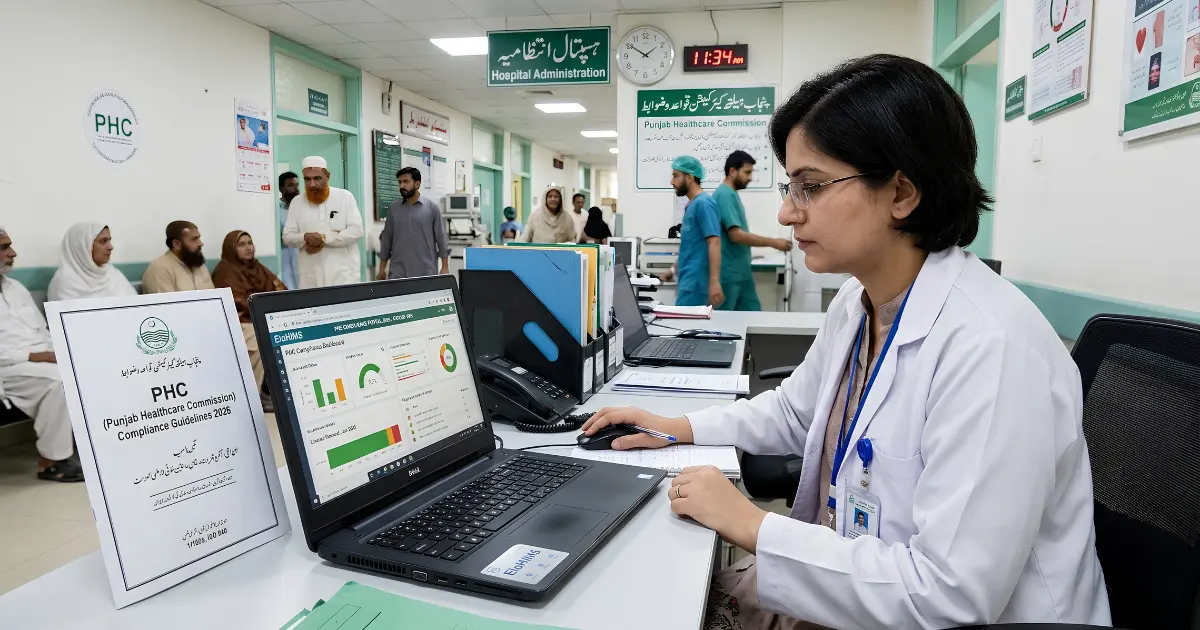
Short answer: in Punjab, a hospital, clinic, laboratory or any other healthcare establishment has to be registered with the Punjab Healthcare Commission (PHC) before it provides healthcare services. PHC describes the route in four steps: registration, a provisional licence, an inspection against its Minimum Service Delivery Standards (MSDS), and the licence. The application form, the MSDS and the current fees are all published by PHC itself, and this guide points you to them rather than repeating figures that change.
Last reviewed: 2 October 2026. PHC updates its forms, fees and procedures from time to time; where this guide and PHC's website differ, PHC's website is right.
Who has to register with PHC
PHC's own wording is that, under Section 13 of the Punjab Healthcare Commission Act 2010, a healthcare service provider shall not provide healthcare services without being registered with the Commission. PHC calls these providers Healthcare Establishments (HCEs) and groups them into categories, from single-doctor clinics to large hospitals, with standards set to match each category. Which category your facility falls into decides which MSDS apply to you, so find your category on PHC's website before you start the form.
If you are opening a new facility, registration comes first. If you are already operating and unsure of your status, PHC's website has a Check Registration Status option.
The four steps PHC describes
1. Registration
The facility applies to be registered as a healthcare establishment. This is the step the law requires before services are provided.
2. Provisional licence
PHC issues a provisional licence once it receives the complete application for licence, with the required documents and fee. PHC is explicit that a provisional licence is not to be taken as compliance with the standards — it lets the establishment operate while the process continues.
3. Inspection against the MSDS
PHC inspects the establishment to assess how far it meets the Minimum Service Delivery Standards relevant to its category. The MSDS are organised by functional area and are published by PHC, along with video tutorials explaining them.
4. Licence
The licence is granted when the establishment meets the MSDS, pays the licensing fee and the grant is approved by PHC's Board of Commissioners.
PHC registration online
PHC runs its applications online. Start from phc.org.pk, where the home page links to Online Registration, the Registration & Licencing Form, Check Registration Status and Check Payment Status. Applications are made through PHC's e-portal at applications.phc.org.pk, and registered establishments sign in to their account through the HCE portal.
PHC registration fee
PHC sets the registration and licensing fees, and they depend on the category of establishment. We deliberately do not quote figures here: fees are revised, and an out-of-date number in a guide is worse than none. Take the current fee from the Registration & Licencing Form on PHC's website, and use PHC's Check Payment Status option to confirm a payment has been received.
PHC registration form and requirements
The Registration & Licencing Form is on PHC's home page. The requirements your facility will be inspected against are the MSDS for your category, which PHC publishes under Download MSDS. Read the MSDS before the inspection, not after it: they describe what the inspectors will look for, area by area, and many of them come down to whether the facility can show its records.
Where your hospital's records come in
An inspection is largely an exercise in showing what the facility does every day — who was admitted and discharged, what happened in theatre, who was seen in emergency, which patients died and how that was handled. Facilities that keep these records on paper usually rebuild them in the week before an inspection. Facilities that keep them in their hospital system simply print them.
This is the part we can speak to. EloHIMS keeps the following records from live activity, as staff do their normal work, rather than as a separate clerical task:
- Births register — each live birth recorded at delivery, with the baby given its own MRN linked to the mother.
- Deaths and mortality register — the death recorded at discharge or in emergency, the certificate's cause chain, police intimation for medico-legal deaths, and body release to a named person with their CNIC.
- Admission, discharge and transfer (ADT) register — every admission, bed move and discharge, with discharge run as a checklist (doctor's order, signed summary, pharmacy returns, bill cleared, bed released).
- Operation theatre register — each case with its Sign-In, Time-Out and Sign-Out, operation note, anaesthesia record and recovery-room discharge.
- Emergency register — arrivals, triage and disposition, with medico-legal cases flagged.
- Consent records — admission, surgical and chemotherapy consents captured by signature on screen, by scan or on a printed form, rather than a tick box.
- Nursing admission assessments — allergies confirmed, fall-risk score and belongings, recorded for each admission.
- Record access log — who opened which patient's file and when, when the hospital switches it on.
See statutory registers in EloHIMS for how each register is built, or clinic management software if you are registering a clinic rather than a hospital.
To be clear about the boundary: software does not register a facility, licence it or make it compliant with the MSDS. Those are PHC's decisions, made on PHC's inspection. What good records do is let you show an inspector what actually happens in your facility without rebuilding it by hand.
Outside Punjab
Other provinces and the federal capital have their own regulators with their own registration and licensing: the Sindh Healthcare Commission, the Khyber Pakhtunkhwa Health Care Commission and the Islamabad Healthcare Regulatory Authority. Their steps, forms and fees differ from PHC's, so use the regulator's own website for the province your facility is in.