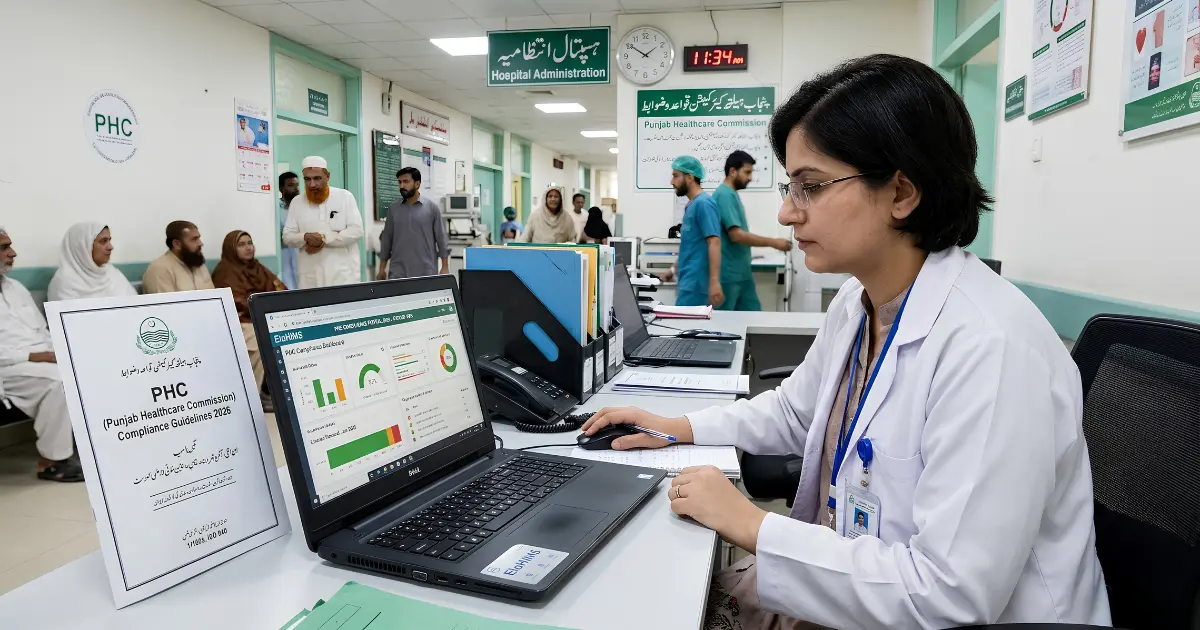
PHC Compliance for Hospitals: What Software Must Do in 2026

PHC (Punjab Healthcare Commission) compliance means meeting Minimum Service Delivery Standards (MSDS) for clinical care, patient safety, infection control, and medical records. Hospitals must maintain statutory registers (births, deaths, ADT, OT, ER), undergo annual inspections, and renew licenses annually. Software that auto-generates these registers from live activity significantly reduces compliance burden.
The Month-End Register Problem
Hospital administrators know the ritual: PHC inspection is scheduled. The compliance officer pulls files from maternity, the ward, and the OT. Clerks transcribe births into the births register, deaths into the mortality ledger, admissions and discharges into the ADT log. The process consumes a week of staff time, introduces transcription errors, and produces registers that are already outdated by the time they're printed.
The stakes are real. License renewal delays, accreditation failures, inspection findings, month-end reconciliation chaos. And beneath the administrative burden sits a simple truth: your hospital recorded every birth, death, admission, discharge, and surgery the moment it happened. The data exists. The problem is that it lives in clinical forms and billing screens, not in the statutory registers your regulators demand.
Modern hospital software closes that gap. The same birth documented in the maternity module auto-populates the births register. The same discharge processed on the ward appears in the ADT register in real-time. Statutory returns shift from a month of clerical work to a single click.
This guide covers PHC, SHCC, and PNAC mandates for Pakistan hospitals, the statutory registers required, the compliance features your software must include, and how automation removes the clerical burden without removing the accountability.
Understanding Pakistan's Healthcare Regulatory Landscape
Three agencies shape hospital compliance in Pakistan: PHC for Punjab, SHCC for Sindh, and PNAC for voluntary quality accreditation. Each has distinct mandates, but all require hospitals to maintain complete, auditable statutory registers.
Punjab Healthcare Commission (PHC)
The PHC regulates all healthcare establishments in Punjab — hospitals, clinics, diagnostic centers, blood banks. Every facility must meet Minimum Service Delivery Standards (MSDS) covering clinical care, infection control, patient safety, human resources, infrastructure, and equipment. Hospitals must maintain five statutory registers (births, deaths, ADT, Operation Theatre, Emergency attendance) and undergo annual inspections for license renewal.
The PHC expects hospitals to maintain a Medical Records Committee (MRC) for mortality review. Deaths must be recorded in a formal mortality register, and high-risk cases or unexpected outcomes should be reviewed by committee with findings documented. Software that links mortality records to MRC review workflows makes this process defensible and audit-ready.
Sindh Healthcare Commission (SHCC)
The SHCC serves the same regulatory role for Sindh province (Karachi, Hyderabad, and surrounding districts). Requirements mirror PHC: minimum standards, statutory registers (births, deaths, ADT, OT, ER), and annual licensing. Hospitals operating in both provinces need systems that maintain separate, isolated registers per facility — multi-branch software with proper tenant isolation handles this requirement.
Pakistan National Accreditation Council (PNAC)
PNAC offers voluntary accreditation for hospitals seeking quality certification. Teaching hospitals, private hospitals targeting international patients, and specialty centers pursue PNAC accreditation to demonstrate standards beyond the PHC/SHCC baseline.
PNAC requirements are more stringent: documented processes, quality indicators, patient safety protocols, infection control logs, equipment maintenance records, staff competency documentation, and mortality/morbidity review workflows. Hospitals pursuing PNAC accreditation need software that goes beyond statutory registers to track quality KPIs, equipment preventive maintenance schedules, and committee-level governance.
Statutory Registers Required for Pakistan Hospitals
Every hospital regulated by PHC or SHCC must maintain five core statutory registers. In most hospitals, clerks compile these manually each month from paper files, ward logs, and OT ledgers. Modern hospital software compiles them automatically from live activity, eliminating manual transcription and keeping registers always current.
1. Births Register
Required by: PHC (Punjab), SHCC (Sindh), PNAC
What it captures: Mother's name, MRN, delivery date and time, delivery type (normal vaginal delivery, assisted delivery, caesarean section), baby's gender, birth weight, attending doctor, and any complications.
Manual process pain: A clerk retrieves delivery records from maternity ward files at month-end, transcribes each birth into a ledger, and hopes nothing was missed. If a delivery wasn't properly filed, it vanishes from the statutory record. If the clerk misreads handwriting, the register contains errors. By the time the register is compiled, it's already weeks out of date.
Software automation (EloHIMS capability): Every delivery recorded in the maternity module auto-feeds the births register the moment it's saved. The labour and delivery record captures delivery type, outcome, and baby details, then populates the births register automatically. The register is always current, always complete, and never dependent on manual transcription. When a PHC inspector requests the births register, you print it on demand — accurate to the last delivery, with a full audit trail showing when each entry was created and by whom.
2. Deaths Register (Mortality Register)
Required by: PHC, SHCC, PNAC
What it captures: Patient name, MRN, date and time of death, location (ward, ICU, ER), cause of death (if known), attending doctor, and Medical Record Committee (MRC) review status.
Manual process pain: Deaths are recorded in ward files or discharge summaries. At month-end, someone compiles them into the mortality register. MRC meetings are held separately, with findings documented in separate minutes — never linked to the actual death records. The result is a fragmented mortality process where the register, the clinical record, and the review findings live in three different places.
Software automation (EloHIMS capability): Structured death capture in the patient chart feeds the mortality register automatically. A dedicated mortality review module supports formal MRC workflow: each death can be linked to committee review findings, with the review date, committee members, and conclusions documented. The system creates a complete death-to-review audit trail — from the moment of death, through the statutory register, to the MRC review — giving you a defensible, compliant outcomes process.
3. Admission-Discharge-Transfer (ADT) Register
Required by: PHC, SHCC, PNAC
What it captures: Every patient admission (date and time, ward, bed, admitting doctor, admitting diagnosis), every discharge (date and time, discharge type: recovered, LAMA, referred, expired), and every inter-ward transfer.
Manual process pain: Admission slips are collected from wards. Discharge summaries are copied. Transfers are noted on ward whiteboards. At month-end, someone assembles all of this into the ADT register — a process prone to missing transfers, incomplete discharges, and timing discrepancies. If a patient was transferred between wards three times, that creates three separate register entries, each dependent on someone remembering to record it.
Software automation (EloHIMS capability): Every admission processed in the Inpatient module appears in the ADT register immediately. Every discharge updates the register in real-time. Every transfer — bed-to-bed, ward-to-ward, department-to-department — is recorded as a first-class event with a timestamp and the user who performed it. The ADT register is never compiled manually; it compiles itself from the actual admissions, discharges, and transfers happening in the system.
4. Operation Theatre (OT) Register
Required by: PHC, SHCC, PNAC
What it captures: Every surgical case (patient name, MRN, date and time, procedure performed, surgeon, anesthetist, implants or prosthetics used, intra-operative complications, and outcome).
Manual process pain: The OT nurse maintains a logbook. Surgeons document procedures in operative notes. At month-end, the logbook entries are transcribed into the formal OT register. Implants used during surgery may be billed separately (or not billed at all, creating revenue leakage). The statutory register, the clinical record, and the billing record are three separate documents that must be manually reconciled.
Software automation (EloHIMS capability): Every theatre case documented in the OT module — with surgeon, anesthetist, procedure, and implants — auto-populates the statutory OT register. Implants recorded during the procedure are auto-billed to the patient's account, closing the revenue leakage gap. The result: zero manual transcription, a complete medico-legal record of every case, and a defensible OT register with full audit trails.
5. Emergency Department Register
Required by: PHC, SHCC, PNAC
What it captures: Every ER attendance (patient name, MRN, arrival date and time, triage category, chief complaint, and disposition: admitted to inpatient, discharged, LAMA, referred out, or expired).
Manual process pain: ER counter staff log arrivals in a paper register. Triage is recorded on cards or whiteboards. Disposition outcomes are added later if remembered. At month-end, someone compiles the paper logs into the formal Emergency register. If the paper register wasn't maintained consistently during busy shifts, the statutory register has gaps.
Software automation (EloHIMS capability): Every ER arrival is registered in the Emergency module — with triage category, vitals, and chief complaint captured at presentation. When the patient is discharged, admitted, or transferred, that disposition is recorded. The Emergency register auto-populates from this activity, always current, with timezone-correct timestamps showing real arrival times and wait durations.
Key Compliance Features Hospital Software Must Have
Beyond statutory registers, PHC and SHCC inspections check for audit trails, mortality review workflows, equipment tracking, and patient-facing Urdu accessibility. Here are the compliance features your hospital software must include.
1. Complete Audit Trail
Every clinical action — orders, results, medications, discharges — must be time-stamped with user ID. The audit log must be tamper-proof: no backdating, no edits without a trail. PHC and SHCC inspections require accountability at the individual-user level. If a medication was administered at 0300, the audit log must show which nurse documented it and when. If a discharge summary was edited after the fact, the audit log must show the original version, the change, and who made it.
EloHIMS provides full audit trails on every action, giving regulators and auditors a defensible record.
2. Medical Records Committee (MRC) Support
PHC and PNAC require hospitals to maintain a Medical Records Committee (MRC) for mortality review. High-risk deaths, unexpected outcomes, and certain categories of mortality must be reviewed by committee, with findings documented.
Software should provide an MRC register that links each death to review findings, committee members, and the date reviewed. EloHIMS includes a structured mortality review workflow with an integrated MRC register, creating a complete death-to-review audit trail for inspections.
3. Biomedical Equipment Management (PNAC Requirement)
PNAC-accredited hospitals must maintain a biomedical equipment register with preventive maintenance (PM) schedules and service history logs. Regulators check whether critical equipment (ventilators, anesthesia machines, monitors, lab analyzers) is serviced on time.
EloHIMS provides a biomedical asset register paired with a PM log. The equipment dashboard shows what's due for service, what's overdue, and what's been serviced recently — giving you a defensible maintenance record for audits.
4. Urdu-Language Patient Records (PHC/SHCC Inspections)
PHC and SHCC inspections in Punjab and Sindh increasingly check for Urdu accessibility in patient-facing documents. Discharge summaries, lab reports, and prescriptions should be available in Urdu where appropriate, so patients and families understand their medical information.
EloHIMS provides Urdu-bilingual output for lab reports and prescriptions, meeting local regulatory expectations while maintaining English clinical records for doctors.
How EloHIMS Supports Compliance
EloHIMS is built for compliance from day one. Here's how the system turns regulatory requirements from a clerical burden into automated workflows.
Automatic Statutory Register Generation
EloHIMS maintains five statutory registers automatically: Births, Deaths, ADT, Operation Theatre, and Emergency. Every clinical event — birth, death, admission, discharge, transfer, OT case, ER attendance — is recorded once in the relevant module. That same event auto-populates the statutory register in real-time.
Outcome: Regulatory returns become a click, not a fortnight. The births register is current to the last delivery. The ADT register reflects every admission and discharge. The OT register captures every theatre case with full audit trails. When PHC or SHCC inspectors request registers, you print them on demand — accurate, complete, and defensible.
Registers are printable in A4 formal register format and 80mm receipt format for submission and filing.
Medical Records Committee (MRC) Workflow
Structured mortality capture feeds the mortality review module, which links to the MRC register. Each death can be tied to committee review findings, committee members, and review date — creating a complete death-to-review audit trail for PHC and PNAC inspections.
Biomedical Equipment Management
The biomedical asset register tracks every piece of equipment. The PM log holds the service schedule and history for each item. The equipment dashboard shows the whole fleet — what's due, what's serviced, what's overdue — in one view. Defensible service history for PNAC audits.
Complete Audit Trail
Every action is time-stamped with user ID. Audit logs are tamper-proof, protecting the hospital in disputes and inspections.
Urdu-Bilingual Output
Lab reports, prescriptions, and discharge summaries can be generated in Urdu for patient clarity. PHC and SHCC inspections in Punjab and Sindh increasingly require Urdu accessibility.
Multi-Branch Compliance (For Hospital Groups)
Multi-tenant isolation ensures each branch's registers are entirely separate. Hospital groups with facilities in Lahore, Karachi, and Islamabad maintain isolated statutory registers per location. Centralized compliance dashboard lets HQ monitor all branches from one screen.
- Schedule a demo to see statutory registers auto-populated from live activity
- Start free trial to explore compliance features
Compliance Checklist for Hospital Administrators
Use this checklist when evaluating hospital software for PHC/SHCC compliance or PNAC accreditation readiness.
RFP Checklist:
- Does the software maintain the 5 statutory registers (Births, Deaths, ADT, OT, ER) automatically from clinical activity?
- Can registers be printed in A4 format for regulatory submission?
- Is there a complete audit trail on every clinical action (time-stamped, user ID, tamper-proof)?
- Does the system support Medical Records Committee (MRC) workflow for mortality review?
- Is there a biomedical equipment register with PM schedule for PNAC audits?
- Can patient-facing documents (discharge summaries, lab reports) be generated in Urdu?
- For multi-branch hospital groups: Are statutory registers isolated per branch (multi-tenant)?
- Is there a compliance dashboard showing register completeness and audit-readiness?
What to avoid:
- Systems requiring manual register compilation at month-end (defeats the purpose)
- Siloed modules where clinical activity doesn't auto-feed registers (data re-entry burden)
- No audit trail or weak audit trail (will fail PHC/SHCC inspection)
Conclusion
PHC, SHCC, and PNAC compliance is non-negotiable for Pakistan hospitals. Statutory registers — births, deaths, ADT, OT, ER — are the foundation. Manual register-keeping consumes staff time, introduces errors, and produces outdated records. Software automation maintains these registers in real-time from live clinical activity, turning regulatory returns from a month-end ordeal into a single click.
Modern hospital software compiles statutory registers automatically because clinical events are recorded once and fed to the appropriate register immediately. A birth documented in maternity populates the births register. A discharge processed on the ward updates the ADT register. A surgery recorded in the OT appears in the theatre register with full audit trails.
EloHIMS maintains 5 statutory registers auto-populated in real-time, supports MRC workflow for mortality review, tracks biomedical equipment PM schedules, provides complete audit trails, offers Urdu-bilingual output, and isolates registers per branch for multi-location hospital groups.
Schedule a demo to see how EloHIMS generates statutory registers automatically, or explore our Laboratory Management System Pakistan: ISO 15189 Compliance Guide for ISO 15189 accreditation requirements.
Sources
- Punjab Healthcare Commission (PHC): https://phc.punjab.gov.pk/ (General mandate and MSDS requirements)
- Sindh Healthcare Commission (SHCC): https://shcc.org.pk/ (Provincial regulatory requirements)
- Pakistan National Accreditation Council (PNAC): https://pnac.gov.pk/ (Voluntary accreditation standards)
Uploading…
Frequently asked questions
What is PHC compliance for hospitals in Pakistan?
PHC (Punjab Healthcare Commission) compliance means meeting Minimum Service Delivery Standards (MSDS) for clinical care, patient safety, infection control, and medical records. Hospitals must maintain statutory registers (births, deaths, ADT, OT, ER), undergo annual inspections, and renew licenses annually. Software that auto-generates these registers from live activity significantly reduces compliance burden.
What statutory registers are required for hospital licensing in Pakistan?
Five statutory registers are required by PHC (Punjab) and SHCC (Sindh): (1) Births Register, (2) Deaths/Mortality Register, (3) Admission-Discharge-Transfer (ADT) Register, (4) Operation Theatre Register, (5) Emergency Department Register. Modern hospital software maintains these automatically from clinical activity, eliminating manual month-end compilation.
How does hospital software help with PHC inspections?
Hospital software helps by maintaining audit-ready statutory registers automatically, providing tamper-proof audit trails on all clinical actions, generating compliance reports on demand, and organizing medical records for inspection. Systems like EloHIMS populate births, deaths, ADT, OT, and ER registers in real-time from clinical activity, so PHC inspectors see complete, current records without manual compilation.
What is PNAC accreditation and how does software support it?
PNAC (Pakistan National Accreditation Council) is a voluntary quality certification for hospitals. Requirements include statutory registers (same as PHC/SHCC), plus quality indicators, patient safety protocols, equipment maintenance records, and mortality review workflows. Software supports PNAC by automating register generation, tracking equipment PM schedules, and providing MRC (Medical Record Committee) workflows.
What is the difference between PHC, SHCC, and PNAC compliance?
PHC (Punjab Healthcare Commission) and SHCC (Sindh Healthcare Commission) are provincial regulators requiring all hospitals to meet Minimum Service Delivery Standards and maintain statutory registers for annual licensing. PNAC (Pakistan National Accreditation Council) is a voluntary national accreditation requiring higher standards: quality indicators, patient safety protocols, and equipment maintenance records. PHC/SHCC = mandatory provincial licensing; PNAC = voluntary quality certification.
Can hospital software generate statutory registers in Urdu?
Yes, compliance-ready hospital software in Pakistan should support Urdu-language output for patient-facing documents (discharge summaries, lab reports, prescriptions). PHC and SHCC inspections increasingly check for Urdu accessibility. EloHIMS provides Urdu-bilingual lab reports and prescriptions while maintaining English clinical records for doctors.
How often must hospitals submit statutory registers to PHC/SHCC?
Hospitals must maintain statutory registers continuously and produce them on demand during PHC/SHCC inspections (typically annual). Some provinces require monthly or quarterly reporting. With manual registers, this means month-end clerical work. With automated systems, registers are always current and can be printed on demand in minutes.